ISC 11>Content>Unit-4>Biomolecules : CARBOHYDRATES
- Carbohydrates- general classification and functions of: monosaccharides (glucose, ribose and deoxyribose), disaccharides (maltose, lactose and sucrose), polysaccharides (glycogen, starch, cellulose, inulin, and chitin).
CLASS PRESENTATION
Carbohydrates:
- CARBOHYDRATES ARE ALDEHYDE OR KETONE DERIVATIVES OF POLYHYDRIC ALCOHOLS.
- Carbohydrates include sugars and the polymers of sugars.

|

|
Sources of carbohydrates

|

|

|
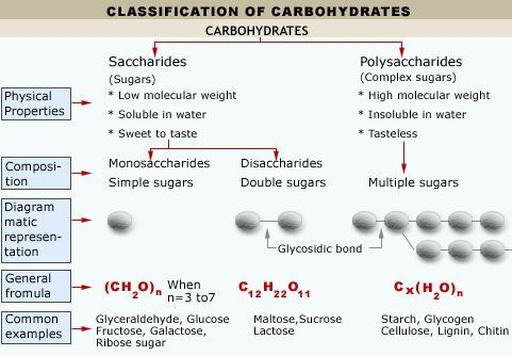
Types (Classification) of carbohydrate
|

|
MONOSACCHARIDES
Monosaccharides are the simplest form of carbohydrates which cannot be broken down to simpler sugar by hydrolysis.
A) Chemical composition:
A) Chemical composition:
- Composed of the elements C, H and O. (H & O in the ratio of 2:1)
- General formula- Cn(H2O)n, n=number of c-atoms where n varies from 3 to 7
- Simple carbohydrate – one saccharide or sugar unit.
- Do not hydrolyze further.
- Sweet in taste.
- Soluble in water.
- Low molecular weight.
- They may be classified on the basis of number of carbon as trioses, tetroses, pentoses, hexoses, or heptoses, depending upon the number of carbon atoms; and as aldoses or ketoses depending upon whether they have an aldehyde or ketone group.

|

|
Aldoses

Ketoses

Most common monosaccharides
- Glucose (6C)
- Fructose (6C)
- Galactose (6C)
- Ribose (5C)
1. Glucose
- Occurs in fruits, like grapes, and honey.
- It is white crystalline solid readily soluble in water and sweet in taste.

2. Fructose
• Most common sugar in fruits, honey.
• Sweetest among all the natural sugar.
• Most common sugar in fruits, honey.
• Sweetest among all the natural sugar.

3. Galactose
- Occurs in combined form as constituent of lactose(is not found free in nature).
- It is rarely found in plants.

4. Ribose and deoxyribose
In DNA : deoxyribose sugar
In RNA: Ribose sugar
In DNA : deoxyribose sugar
In RNA: Ribose sugar

Drawing the Cyclic Structure : Glucose

|

|

|
D and L Notations

|
Alpha and beta forms

|
Reference link :
Functions of monosaccharides
- Have important role in metabolism.
- Trioses, pentoses, heptosse etc are intermediates in the pathway of photosynthesis.
- Glucose is broken to release energy during respiration.
- Mammary glands synthesise lactose from glucose.
- Ribose and deoxy ribose are components of nucleic acids.
- Used in synthesis of fats and amino acids.
DISACCHARIDES
- These are carbohydrates that yield two molecules of same or different types of monosaccharides on hydrolysis.
- The general formulais Cn(H2O)n-1
LACTOSE


|
MALTOSE

|
SUCROSE

|
Glycosidic bond
A glycosidic bond is a type of covalent bond that joins a carbohydrate molecule to another group, which may or may not be another carbohydrate.
- The subunits of disaccharides and polysaccharides are linked by glycosidic bonds.
- During this bond formation water is formed and thus is called as Condensation.

|

|
POLYSACCHARIDES
Polysaccharides are long carbohydrates molecules of repeated monomer units joined together by glycosidic bonds.

|

|
- These are polymers of monosaccharides joined together by glycosidic linkage, between 1st and 4th C-atom of two units.
- Number of monomers- 10 to thousands.
- High molecular weight and colloidal size.
- Branched or unbranched linear chains
- Sparingly soluble in water.
Polysaccharides :Classification
|
1) Based on Composition
A. Homopolysaccharides
|
2) Based on functions
A) Food storage polysaccharides : Starch, Glycogen, Inulin B) Structural polysaccharide: Cellulose, Chitin C) Mucopolysaccharides : |
Common polysaccharides
1. STARCH
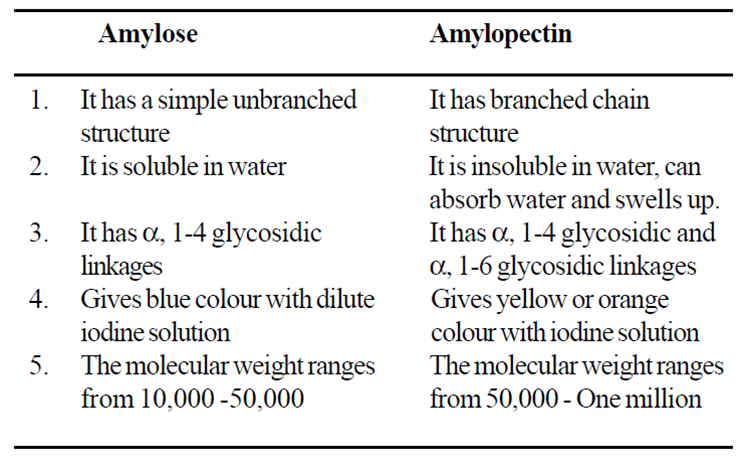
- Starch is a homopolymer of glucose forming an α- glycosidic chain, called a glucosan or glucan.
- It is the most abundant dietary carbohydrate in cereals, potatoes, legumes, and other vegetables.
- The two main constituents are amylose (15–20%), which has a nonbranching helical structure and amylopectin (80–85%), which consists of branched chains composed of 24–30 glucose residues united by 1 → 4 linkages in the chains and by 1 → 6 linkages at the branch points

a) AMYLOSE

b) AMYLOPECTIN
|

c) the starch-iodine complex.
|
2. GLYCOGEN
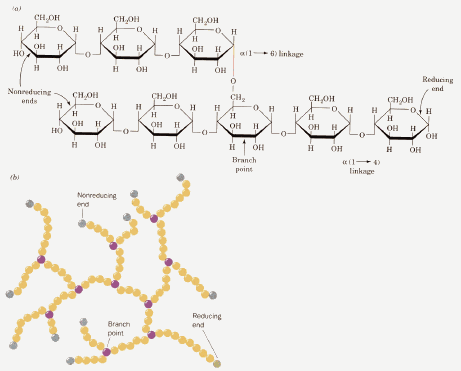
- Glycogen is the storage homopolysaccharide in animals.
- It is a more highly branched structure than amylopectin, with chains of 12–14 α -D-glucose residues (in α[1 → 4]-glycosidic linkage), with branching by means of α(1 → 6)-glycosidic bonds.
- It is mainly stored in the muscles and liver of mammals.
- Fungi also store food in the form of glycogen.
- The glycogen is converted to glucose as and when required.Hydrolysis
|

|
3. INULIN
- Inulin is a polysaccharide of fructose (and hence a fructosan) found in tubers and roots of dahlias, artichokes, and dandelions.
- Fructose units are joined by β-2,1 linkage.
- It is readily soluble in water and is used to determine the glomerular filtration rate.

|
Dandelion

|
4. CELLULOSE
- Fibrous, tough, water insoluble.
- Wood (25-50%) and cotton (90%) contains cellulose.
- Form long tensile fibers that form bundles called microfibrils.
- They are held by hydrogen bonds.
- Animals digest, humans cannot – form roughage.

|

|
USES OF CELLULOSE
- Cellulose-containing material are used for shelter, fuel, tools etc.
- Fibres of cotton, jute and linen are used for making textile, ropes and bags.
- In synthesis of artificial rayon.
- Cellulose acetate is used to make plastics and shatter-proof glass.
- Cellulose nitrate is used in propellant explosives.
- Carboxymethyl cellulose is added to ice-creams, cosmetics and medicine to emulsify and to give smooth texture.
- Cellulose rich wood is used in building furniture, tools, sports article etc.
- Cellulose rich plant material are used in making paper.
- Major component of roughage.
5. CHITIN
- Chitin is a structural polysaccharide found in the exoskeleton of insects,crabs, lobsters and cell wall of fungi.
- Composed of units of N-acetyl--D-glucosamine joined by 1,4-glycosidic bonds.
- Being insoluble in water, chitin helps organisms in retaining the form and strengthening the structure.

Exoskeleton of insects
|

|

6. MUCOPOLYSACCHARIDES
- Peptidoglycan :Occur in cell wall of bacteria.
- Mucilage: Slimy substance produced by plants. (mucilage), Isabgol seeds,
- Hyaluronic acid: matrix of connective tissues and as a synovial fluid.
- Heparin: Anticoagulant
- Pectin : Component of cell wall and middle lamella
- Agar- agar: Obtained from sea weeds, polymer of galactose.
Functions of Polysaccharides
- Storage food: Starch and glycogen
- Energy :Hydrolysis of starch and glycogen give glucose units.
- Structural compounds:Cellulose, chitin and peptidoglycan
- Protective coat: Mucilage forms protective coat around aquatic plants, algae and bacteria.
- Anticoagulant: Heparin prevents blood clotting in blood vessels.
- Lubricant :Hyaluronic acid acts as a lubricant.
- Medicinal importance: Some mucopolysaccharides like husk of Plantago ovata (Isabgol), mucilage of aloe, agar, carageen obtained from marine algae source of medicinal and commercial value.
- Immunological reactions: Glycoprotein and glycolipids present at cell surface recognise stimuli reaching the cells.
