ISC 12>APPLICATIONS OF BIOLOGY> 4. HUMAN DEFENSE MECHANISM
|
Human Diseases: body’s defence mechanisms: (specific and non-specific); immune disorders (SCID and AIDS); allergies, interferons.
Skin, blood vessels, WBC, antibodies to be discussed as non-specific defence mechanisms; Humoral and cell-mediated immune system; antibody and antigen; cells of the immune system; mechanism of action of T cells to antigens; brief idea of SCID and AIDS; Organ transplants and brief idea of immuno-supressants. Role of stem cells in medical treatment. |
|
DISEASE
|
Any departure from health, presenting marked symptoms and illness disorders.
Disease is caused by an agent. This causative agent is called as pathogen. When the pathogen succeeds in establishing itself inside the organism then it results in infection. |
|
Koch's postulates
Jacob Henle formulated the germ theory of disease and outlined the procedure that demonstrating that various microbial species causes particular disease. However, this was proved experimentally later by Robert Koch. Koch proved that a particular microorganism caused a specific disease, thus establishing a set of criterias. This is called as Koch's postulates-
There are four postulates
There are four postulates
- The microorganism or other pathogen must be present in all cases of the disease.
- The pathogen can be isolated from the diseased host and grown in pure culture.
- The pathogen from the pure culture must cause the disease when inoculated into a healthy, susceptible laboratory animal.
- The pathogen must be reisolated from the new host and shown to be the same as the originally inoculated pathogen.
Causes of infection
|
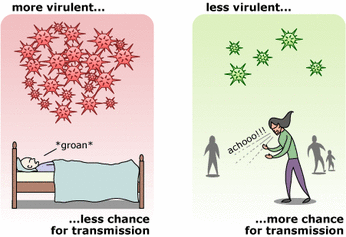
Pathogenecity- ability of a micro-organism to cause a disease.
Virulence- capacity of a given strain of microorganism to produce a disease. Pathogenecity and virulence of the pathogen and susceptibility of the host are the major factors for establishing a disease. Invasiveness, Toxigenecity are other factors. |
|
Barriers to invasion by pathogens
|
The resistance depends upon environmental conditions and genetic constitution of the host.
Defensive mechanism determines the extent and severity of infection. The ability of an organism to resist the development of a disease or the effect likely to be produced by the entry of foreign organisms is called immunity. |
|
BODY'S DEFENCE MECHANISM
|
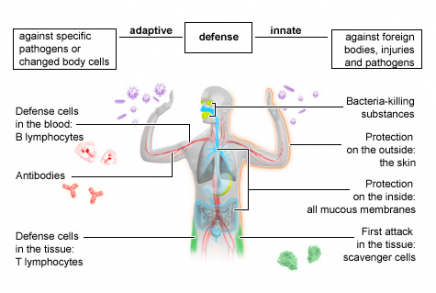
Human body has two lines of defence against pathogens-
Non-specific mechanism This is the most common mechanism for almost all types of infections. This is of two types-
Specific defence mechanism This based on the ability of the immune system to recognise the self and non self proteins it Humoral immune system Cell mediated immune system |
|
Non-specific mechanism
|
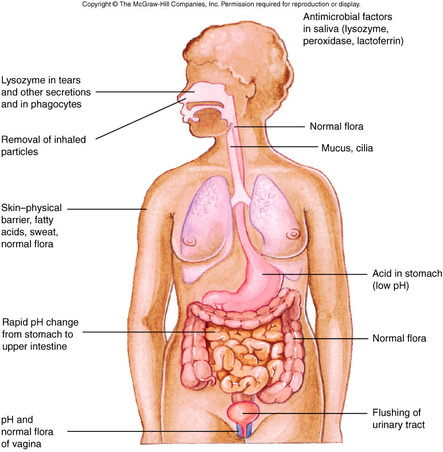
First line of defence
The first line of defence Protective surface phenomenon.
|
|
Second line of defence or Internal defence
Internal or second line of defence is carried out when the pathogen manages to break the first line of defence.
The second line of defence is carried out by -
1. Leucocytes (WBC)
Leucocytes especially the neutrophils engulf the invading microbes by the process of phagocytosis.
2. Macrophages-
These are phagocytic cells located in the tissues, lymph nodes, spleen and lining of blood vessels. These macrophages are of two types-
Wandering macrophages are found in the connective tissues throughout the body.
Fixed macrophages are located in the spleen, lymph nodes, liver and bone marrow.
These two macrophages together form the reticulo-endothelial system. Like the leucocytes these cells also help in disposing off the microbes and also remove the tissue debris and the dead cells.
3. Mast cells
These cells are found scattered in the connective tissue throughout the body near the blood vessels. These cells release histamine and serotonin that increase the permeability of the blood vessels and cause local oedema. They also secrete heparin which is an anticoagulant.
4. Inflammatory reaction
The micro-organisms that enter the body produce toxic substances that kill tissue cells. These cells release histamine that causes inflammation. The capillaries dilate and become more permeable which causes swelling and redness in the area. Phagocytes move to this area engulfing the microbes. This is termed as inflammatory reaction.
5. Fever
During acute inflammation- some pathogens invoke a multi-factorial tissue response.
The inflammation can be restricted locally only to the specific area called as local inflammation.
When the inflammation spreads all over the body it is called systemic inflammation. WBC count increases.
Pyrogens released by the WBCs and toxins produced by the pathogens cause regulation of body temperature.
The second line of defence is carried out by -
1. Leucocytes (WBC)
Leucocytes especially the neutrophils engulf the invading microbes by the process of phagocytosis.
2. Macrophages-
These are phagocytic cells located in the tissues, lymph nodes, spleen and lining of blood vessels. These macrophages are of two types-
Wandering macrophages are found in the connective tissues throughout the body.
Fixed macrophages are located in the spleen, lymph nodes, liver and bone marrow.
These two macrophages together form the reticulo-endothelial system. Like the leucocytes these cells also help in disposing off the microbes and also remove the tissue debris and the dead cells.
3. Mast cells
These cells are found scattered in the connective tissue throughout the body near the blood vessels. These cells release histamine and serotonin that increase the permeability of the blood vessels and cause local oedema. They also secrete heparin which is an anticoagulant.
4. Inflammatory reaction
The micro-organisms that enter the body produce toxic substances that kill tissue cells. These cells release histamine that causes inflammation. The capillaries dilate and become more permeable which causes swelling and redness in the area. Phagocytes move to this area engulfing the microbes. This is termed as inflammatory reaction.
5. Fever
During acute inflammation- some pathogens invoke a multi-factorial tissue response.
The inflammation can be restricted locally only to the specific area called as local inflammation.
When the inflammation spreads all over the body it is called systemic inflammation. WBC count increases.
Pyrogens released by the WBCs and toxins produced by the pathogens cause regulation of body temperature.
|
4. Inflammatory reaction
The micro-organisms that enter the body produce toxic substances that kill tissue cells. These cells release histamine that causes inflammation. The capillaries dilate and become more permeable which causes swelling and redness in the area. Phagocytes move to this area engulfing the microbes. This is termed as inflammatory reaction. 5. Fever During acute inflammation- some pathogens invoke a multi-factorial tissue response. The inflammation can be restricted locally only to the specific area called as local inflammation. When the inflammation spreads all over the body it is called systemic inflammation. WBC count increases. Pyrogens released by the WBCs and toxins produced by the pathogens cause regulation of body temperature. |
|
IMMUNE SYSTEM AND THE IMMUNE RESPONSE
|
The cells of immune system are phagocytes (neutrophils and Macrophages) and lymphocytes.
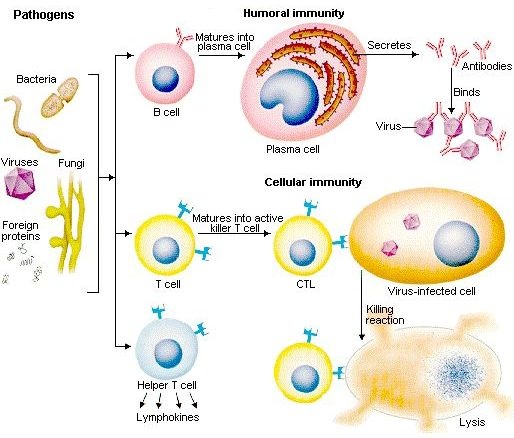
Immune system has two components- Humoral Immune response: This consists of the various proteins present in the lymph and plasma. These are called antibodies. This system defends against the bacteria and virus that enter the blood. These antibodies inactivate the bacteria or virus which is then disposed off by the phagocytes. However, both B and T lymphocytes, as well as dendritic cells and other antigen presenting cells, are necessary for the formation of antigen-specific antibody. Cellular or cell mediated immune response defends against pathogens including fungi and protists entering the body. Also against tissue implant and cancer cells These responses may occur separately or together. LYMPHOCYTES arise from cells called HAEMOCYTOBLASTS. Some migrate to thymus forming T cells (cellular immunity) Others develop in bone marrow forming B cells (produce antibodies) |
|
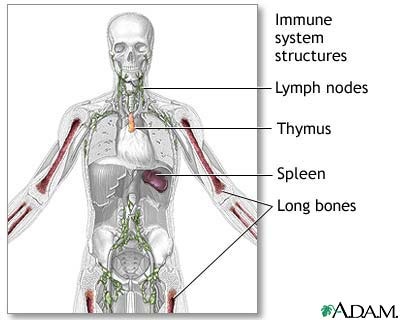
LYMPHOID ORGANS
|
Thymus:
Production of T lymphocytes and modification of B lymphocytes. Lymph nodes: Filtration of bacteria by phagocytosis with the macrophages. Storage and proliferation of B and T lymphocytes and antibody production. Spleen: Multiplication of B and T cells and destruction of blood cells. 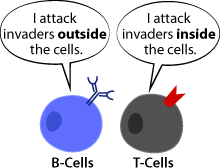
|
|
RESPONSE OF B-CELLS
|
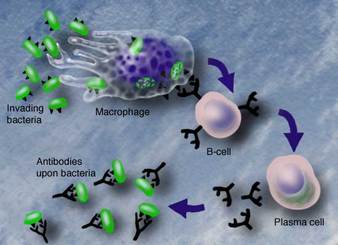
B cells circulate in the blood and make contact with antigens taken up and processed by macrophages.
On activation by the helper T cells they divide to form a clone of cells. Some of these become plasmablasts which divide forming antibody producing cells called plasma cells. These B cells produce antibodies and are programmed to recognize only one antigen. Some of the clone cells become memory cells. These cells do not produce any antibodies. However they are stored in the spleen and lymph nodes. This is acquired or active immunity. |
|
ANTIGEN AND ANTIBODY
|
|
ANTIGEN
It is a substance when introduced into a vertebrate host provokes an immune response leading to acquired immunity. ANTIBODIES Specific proteins synthesized by the host in response to an antigen. All antibody molecules are immunoglobulins. These are of 5 types IgG, IgM, IgA, IgD and IgE. Monomeric with two light and two heavy chains. |
Mechanism of action of antibodies
Antibody not only binds to a bacteria, but cannot destroy them.
They tag the antigens which are then destroyed by other mechanisms- Effector mechanisms.
Mechanism of action
They tag the antigens which are then destroyed by other mechanisms- Effector mechanisms.
Mechanism of action
- Agglutination- antibodies bind with antigens to produce large insoluble complexes.
- Opsonisation- antibodies bind to antigens making it more susceptible to phagocytosis.
- Complement mediated cell lysis- these are highly specialised proteins. Bind to antigen and directly or indirectly kill them. They are triggered by IgM-IgG.
RESPONSE OF T CELLS
T cells contain specialized antibody-like receptors that see fragments of antigens on the surfaces of infected or cancerous cells. They are unable to recognise the free floating antigens. T cells contribute to immune defences in two main ways:
1. Some cells direct and regulate immune responses, these are Helper T cells
Helper T cells, or Th cells, work by communicating with other cells.
Some of these cells stimulate nearby B cells to produce antibodies, some others stimulate the microbe-gobbling cells called phagocytes, and still others activate other T cells.
1. Some cells direct and regulate immune responses, these are Helper T cells
Helper T cells, or Th cells, work by communicating with other cells.
Some of these cells stimulate nearby B cells to produce antibodies, some others stimulate the microbe-gobbling cells called phagocytes, and still others activate other T cells.
|
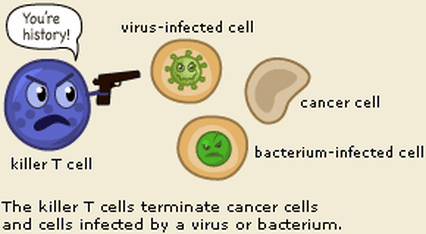
2. Some cells directly attack infected or cancerous cells, these are Cytotoxic or killer T cells
Cytotoxic T lymphocytes (CTLs)—also called killer T cells—perform a different function. T cells when activated produce clone of T cells These cells are capable of directly attacking other cells carrying certain foreign or abnormal molecules on their surfaces. These are thus especially useful for attacking viruses because viruses often hide from other parts of the immune system while they grow inside infected cells. CTLs recognize small fragments of these viruses on the cell membrane and launch an attack to kill the infected cell As the infection is brought under control, the activated T and B cells are turned off by suppressor T cells. These cells suppress the immune system from attacking body’s own cells. They are also referred to as memory cells. |
|
HOW DOES THE HUMAN BODY PROTECT ITSELF FROM INFECTION?
- Human skin is tough which prevents the entry of bacterial and viruses.
- Prespiration contains the enzyme lysozyme that destroys the cell walls of many bacteria.
- Secretion of gastric juice kills foreign bodies in the stomach.
- Saliva contains lysozyme which attacks bacteria.
- Respiratory tract is lined with mucus membrane and the nostrils have a mesh of fine hair to capture foreign particles.
- Antibodies are produced in the blood of man to combat toxic effects of parasitic micro-organisms.
IMMUNITY
The ability of an organism to resist the development of a disease or the effect likely to be produced by the entry of foreign organisms.
A person may develop immunity by-
1. Through disease- when a person gets infected by a disease for the first time the he suffers from the disease and produces the antibodies. For e.g. Chicken pox or mumps. However the next time the antibodies are already present hence the person does not suffer from the disease.
2. Antitoxins- during infection, toxins enter the body. Antibodies that neutralize these toxins are antitoxins. These are now prepared artificially like the antitoxin for snake venom.
3. Vaccination- A process by which immunity is gained without suffering from disease. Vaccines are dead or weakened pathogens. These are injected in the body to make the body immune against a particular pathogen. The pathogens that are injected into the body are not capable of developing a disease, however they stimulate an immune response and produces antibodies. Thus the person gains immunity against a particular disease without contacting the disease.
A person may develop immunity by-
1. Through disease- when a person gets infected by a disease for the first time the he suffers from the disease and produces the antibodies. For e.g. Chicken pox or mumps. However the next time the antibodies are already present hence the person does not suffer from the disease.
2. Antitoxins- during infection, toxins enter the body. Antibodies that neutralize these toxins are antitoxins. These are now prepared artificially like the antitoxin for snake venom.
3. Vaccination- A process by which immunity is gained without suffering from disease. Vaccines are dead or weakened pathogens. These are injected in the body to make the body immune against a particular pathogen. The pathogens that are injected into the body are not capable of developing a disease, however they stimulate an immune response and produces antibodies. Thus the person gains immunity against a particular disease without contacting the disease.
TYPES OF IMMUNITY
Innate or inborn or natural Immunity
The immunity inherited by an organism from the mother that protects the person for lifetime. For e.g. human beings have immunity against distemper a disease of dogs.
Acquired or adaptive immunity
The immunity developed by a person during his lifetime is called acquired immunity. This type of immunity involves the formation of antibodies in the body.
Acquired immunity can be active or passive
Active immunity is acquired by producing antibodies in the body. This immunity generally lasts for a lifetime. It can develop by contacting a disease where the body produces the antibodies. This is called natural active acquired immunity.
A person develops antibodies without contacting disease by the introduction of vaccines. This type of immunity is called artificial active acquired immunity.
Passive immunity is acquired when the body receives antibodies that are formed in some other organism. This can be in the form of serum. This type of immunity lasts only for a short period, even though it provides immediate relief. Natural form of this is antibodies entering from the mother’s first milk.
The immunity inherited by an organism from the mother that protects the person for lifetime. For e.g. human beings have immunity against distemper a disease of dogs.
Acquired or adaptive immunity
The immunity developed by a person during his lifetime is called acquired immunity. This type of immunity involves the formation of antibodies in the body.
Acquired immunity can be active or passive
Active immunity is acquired by producing antibodies in the body. This immunity generally lasts for a lifetime. It can develop by contacting a disease where the body produces the antibodies. This is called natural active acquired immunity.
A person develops antibodies without contacting disease by the introduction of vaccines. This type of immunity is called artificial active acquired immunity.
Passive immunity is acquired when the body receives antibodies that are formed in some other organism. This can be in the form of serum. This type of immunity lasts only for a short period, even though it provides immediate relief. Natural form of this is antibodies entering from the mother’s first milk.
Autoimmunity
This is a type of abnormality in the form of a response where the individual develops antibodies against his own antigens. Autoimmunity involves attacking of body's own cells instead of foreign cells. It depends on the self antigen involved, if it is against the RBC, all the RBCs are destroyed leading to chronic anaemia.
This type of diseases are called autoimmune diseases.
Immunodeficiency disorders
Severe combined immunodeficiency (SCID)
T and B cells are absent, the individual is born without B cells and T cells.
Thus the patient is susceptible to even minor infections.
Children with SCID are kept in germ free ‘isolation suits’
This type of diseases are called autoimmune diseases.
Immunodeficiency disorders
Severe combined immunodeficiency (SCID)
T and B cells are absent, the individual is born without B cells and T cells.
Thus the patient is susceptible to even minor infections.
Children with SCID are kept in germ free ‘isolation suits’
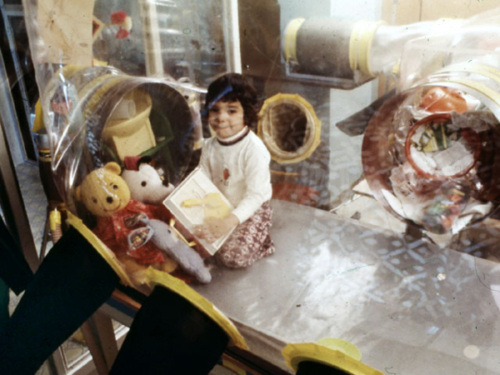
A child suffering from SCID in an isolation suit.
Acquired Immunodeficiency Syndrome (AIDS)
AIDS is caused by a reterovirus, Human Immunodeficiency Virus. These virus infect the T cells and can remain there for 6 months to 5 years. They convert this cell into a cell producing HIV. Thus these cells are unable to stimulate B cells for production of antibodies.
Individuals then develop Aids Related Complexes (ARC).
This virus is found in body fluids like blood and semen. This a highly contagious disease.
The virus was first isolated by Dr. Luc -Montagnier.
Individuals then develop Aids Related Complexes (ARC).
This virus is found in body fluids like blood and semen. This a highly contagious disease.
The virus was first isolated by Dr. Luc -Montagnier.
Modes of transmission of AIDS.
AIDS is spread by the following ways-
1. Sexual intercourse- HIV is found in semen and vaginal fluid. This can be transmitted from man to woman or woman to man.
2. Blood and blood components- transfusion of HIV contaiminated blood.
3. Shared needles- Sharing needles and syringes, or using of instruments like ear peircing or tatoo needles.
4. Mother to child- Woman infected with HIV may pass it to her child by breast feeding.
5. Organ transplant and artificial insemination.
1. Sexual intercourse- HIV is found in semen and vaginal fluid. This can be transmitted from man to woman or woman to man.
2. Blood and blood components- transfusion of HIV contaiminated blood.
3. Shared needles- Sharing needles and syringes, or using of instruments like ear peircing or tatoo needles.
4. Mother to child- Woman infected with HIV may pass it to her child by breast feeding.
5. Organ transplant and artificial insemination.
Symptoms, treatment and control of AIDS
Symptoms may begin with simple fever, cough, slight but recurring diahorrea, rashes on the skin. Some may develop lung infection or cancer that affects the skin and lining of blood vessels. AIDS has a long incubation period, however once it develops, there is a rapid decline in the health of the person and can lead to death of the individual.
Treatment- There is no cure for the AIDS till date. Azidothymidine is a drug that prolongs the life of the AID
Treatment- There is no cure for the AIDS till date. Azidothymidine is a drug that prolongs the life of the AID
Interferons
Interferons discovered by Alick Isaacs and Jean Lindermann.
When a cell is infected with viruses, it produces a protein this is called as interferon.
These are body’s first line of defence against viruses.
These are species specific and can interfere with the replication of viruses.
It brings about an “anti viral state”.
When a cell is infected with viruses, it produces a protein this is called as interferon.
These are body’s first line of defence against viruses.
These are species specific and can interfere with the replication of viruses.
It brings about an “anti viral state”.
Organ transplant and immunosuppression
Replacement of diseased tissues or organs by healthy ones is called transplantation. Due the advances in surgery transplantation has become a common reality. However there are limitations to this, as the body rejects the transplanted tissue or organ and an immune response is triggered.
A graft taken from a different person is called allograft whereas a graft taken from one’s own body is called autograft.
Allografts are less successful than autografts. In autografts there is no rejection.
For allografts, tissue matching is done to ensure that there is no rejection.
Immunosuppression- The suppression of a part of immune system that is triggered by transplanted organ while the rest of the immune system may remain active to fight other invaders.
Immunosuppressants are drugs that are suppress the immune system temporarily, to prevent rejection of transplant.
A graft taken from a different person is called allograft whereas a graft taken from one’s own body is called autograft.
Allografts are less successful than autografts. In autografts there is no rejection.
For allografts, tissue matching is done to ensure that there is no rejection.
Immunosuppression- The suppression of a part of immune system that is triggered by transplanted organ while the rest of the immune system may remain active to fight other invaders.
Immunosuppressants are drugs that are suppress the immune system temporarily, to prevent rejection of transplant.
Stem cells
These cells have the capacity to self renew by cell division and to differentiate. At an early stage the whole of a human embryo consists of stem cells, but gradually the cells in the embryo become committed to differentiating in a particular way.
There are two types of stem cells- embryonic stem cells and adult stem cells.
Embryonic stem cells have a greater capacity to differentiate into different cell types than adult stem cells.
Therapeutic or medicinal uses of stem cells
Juvenile onset diabetes can be treated by transplanting pancreas tissue from donors after the death. However, the supply is limited. Stem cells have had success with bone marrow transplants. Hematopoietic stem cell, normally found in the bone marrow, divide to produce new cells that differentiate into RBC and WBC.
These cells are used in the treatment of variety of blood disorders like leukemia, SCID, multiple myeloma and lymphoma.
Embryonic stem cells can also be used to treat diseases like Alzheimer’s Parkinson’s. It could also be used to sickle cell anemia, cystic fibrosis etc.
Stem cells also have risks associated during stem cell therapies. Stem cells can form tumors called teratocarcinomas in which rapid division occurs and up to 30 different tissue types aree formed by cell differentiation.
There are two types of stem cells- embryonic stem cells and adult stem cells.
Embryonic stem cells have a greater capacity to differentiate into different cell types than adult stem cells.
Therapeutic or medicinal uses of stem cells
Juvenile onset diabetes can be treated by transplanting pancreas tissue from donors after the death. However, the supply is limited. Stem cells have had success with bone marrow transplants. Hematopoietic stem cell, normally found in the bone marrow, divide to produce new cells that differentiate into RBC and WBC.
These cells are used in the treatment of variety of blood disorders like leukemia, SCID, multiple myeloma and lymphoma.
Embryonic stem cells can also be used to treat diseases like Alzheimer’s Parkinson’s. It could also be used to sickle cell anemia, cystic fibrosis etc.
Stem cells also have risks associated during stem cell therapies. Stem cells can form tumors called teratocarcinomas in which rapid division occurs and up to 30 different tissue types aree formed by cell differentiation.
ALLERGY
|
An inappropriate reaction or response of a person due to hyper-sensitivity of substances coming incontact with the body is called allergy.
The substances that causes allergy are called allergens. Allergic reactions results due to liberation of histamines or histamine like substances by the tissues. Histamines are present in tissue cells called as mast cells and basophil cells of blood. Allergy-symptoms Most common reactions are itching, skin eruptions, sneezing etc.
When a person gets a severe shock of an injection of some foreign substance it is called ANAPHYLACTIC SHOCK. This happens due to bee or wasp sting. |
|
